Synchronized Consciousness
DMT, Shared Perception, and the Nature of God
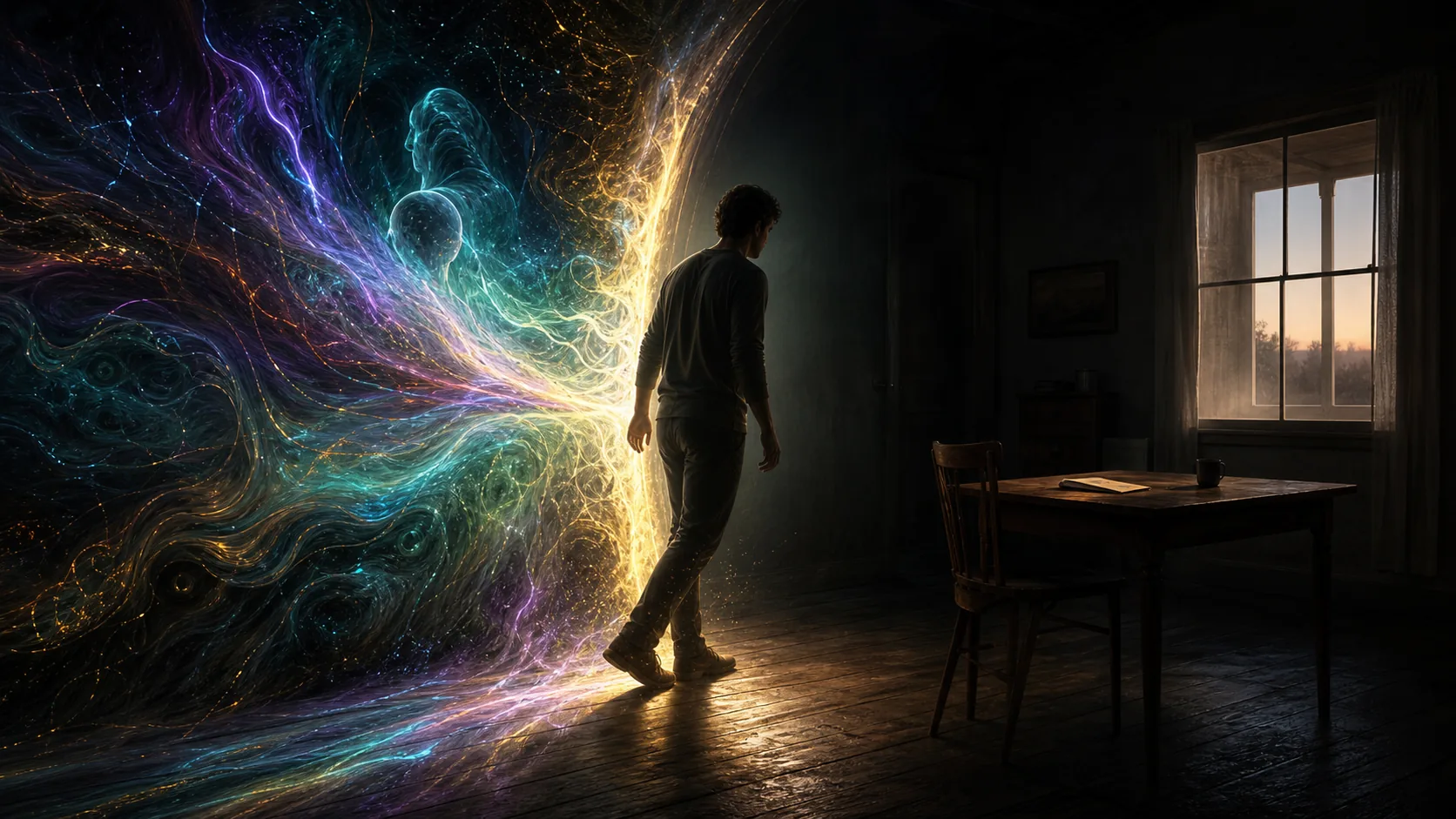
The Question
Reports of closely matching psychedelic perceptions raise a question that has not been adequately tested. When two people receive the same drug, sensory input, and social cues, can their experiences become aligned closely enough for them to perceive substantially similar conscious content?
Such reports are not proof of telepathy, literal mind fusion, or a supernatural realm. They are uncontrolled observations with several plausible explanations. Yet dismissing them as “only subjective” also misses an opportunity to study how perception may become coordinated between people.
The better question is:
Can consciousness remain individually experienced while becoming temporarily synchronized?
What I Mean by Synchronized Consciousness
I use synchronized consciousness to describe a condition in which distinct minds become sufficiently aligned through shared neurochemistry, sensory input, attention, pattern interpretation, and reciprocal feedback that they participate in substantially similar conscious content.
This definition does not claim that two brains literally become one brain. Each person retains an individual point of view. Yet the processes constructing their experiences may become aligned closely enough for both to inhabit a temporarily shared perceptual pattern.
The proposed ingredients include:
- Shared neurochemistry: both minds are altered by the same substance.
- Shared visual and auditory priming: both receive the same images and sounds.
- Similar perceptual architecture: human brains share systems for detecting faces, skin, texture, color, biological irregularity, and motion.
- Mutual attention: participants attend closely to one another.
- Reciprocal feedback: each expression and movement becomes new information for the other.
- A shared physical anchor: movement, reflected light, environmental particles, or another changing event gives both minds the same sensory material to interpret.
A concise model is:
Shared stimulus + similar altered state + mutual attention + reciprocal feedback = a synchronized perceptual field.
This model explains how experiences could align without requiring direct transmission of private thoughts. It also leaves a further question open: can ordinary sensory exchange account for every precise match, or could information sometimes pass between people in a way not yet identified?
Subjective Does Not Mean Isolated
We often use subjective to mean private, unreliable, or unreal. That is a mistake. Pain is subjective and real. Love is subjective and changes behavior. Music is physically present as vibration, but the heard melody is an experience constructed by a nervous system.
Subjective experience is also rarely produced in isolation. Two people watch the same film and become tense at the same moment. A crowd begins moving to one rhythm. People in conversation unconsciously match posture, timing, expression, and emotional tone. A shared joke can reorganize the meaning of a room instantly.
Researchers using simultaneous EEG recordings have measured interbrain synchronization during speaking and listening, cooperation, music, and shared attention. These findings do not demonstrate merged consciousness. Much of the synchronization can arise because people receive the same stimulus, coordinate behavior, and continuously influence one another. But that is exactly the point: individual consciousness is normally more relational than it feels from inside one skull.
DMT may intensify this ordinary relational capacity. It changes communication among brain networks and weakens some of the boundaries that normally stabilize the self and its predictions. Shared sensory material and another person's reactions may therefore exert unusually strong influence over what becomes perceptually real.
What Existing Science Explains
Current theories provide several plausible parts of the explanation.
Predictive processing: perception is not a passive recording. The brain combines sensory information with expectations to construct its best current model of what is happening. DMT may weaken the usual dominance of high-level predictions, allowing imagery, emotion, context, and incoming sensation to combine more freely.
Shared priming: common faces, patterns, colors, textures, and sounds could prepare two brains to organize later perception in similar ways.
Pattern completion: once a few features suggest an image, both visual systems could complete the same kind of form—just as people can recognize the same face in an incomplete drawing.
Social feedback: one person's expression could confirm the other's perception without deliberate speech. Gaze, surprise, posture, and movement communicate continuously.
A real moving stimulus: when both people observe the same motion, particles or changes in light may be interpreted through the same altered perceptual model.
Together, these mechanisms make synchronized perception possible without invoking telepathy. They are not excuses invented to make the extraordinary disappear. They show that two consciousnesses can become aligned through identifiable relationships among brains, bodies, environment, and attention.
What Existing Science Does Not Yet Establish
No controlled study has demonstrated that two people using DMT exchange hidden information, enter one objectively shared visionary location, or form a literal collective mind. Research on interbrain synchrony also warns against equating similar electrical rhythms with identical information. Two brains can synchronize partly because both are following the same stimulus.
At the same time, DMT research has documented features that deserve explanation. In one naturalistic field study, 34 of 36 breakthrough experiences included an apparently autonomous entity. Participants described coherent environments, purposeful beings, and communication often experienced as immediate knowledge rather than speech. A Johns Hopkins survey of 2,561 entity encounters found that 69 percent reported receiving a message, task, purpose, or insight. Many participants attributed lasting changes in meaning, purpose, and worldview to the event.
These studies establish recurring human experiences and their effects. They do not establish the external existence of entities or collective consciousness. The difficult unanswered features include the experiences' coherence, recurring motifs, autonomous quality, hyperreality, and ability to reorganize a person's worldview within minutes.
This leaves a question that has not yet been adequately studied: how precisely can two DMT experiences align when participants share stimuli and interact in real time?
How the Claim Could Be Tested
A serious test would separate ordinary synchronization from information transfer beyond known channels.
- Pairs would be medically screened and participate only in a lawful, ethically approved research setting.
- Expectations and prior knowledge of DMT imagery would be documented beforehand.
- Some pairs would share a controlled audiovisual stimulus while others received different or placebo stimuli.
- Participants would be separated during part of the experience so they could not see, hear, or cue one another.
- Each person would independently describe or draw the experience immediately, before any discussion.
- Some sessions would include randomly selected hidden targets visible to only one participant.
- Blinded evaluators would score exact matches and mismatches using criteria defined before the study.
- Simultaneous EEG or other recording could measure coordination, but verifiable transfer of hidden information would be the stronger test.
If matched details occurred primarily when people shared stimuli, the synchronized-perception model would gain support. If separated participants repeatedly identified hidden targets or reported the same unexpected details far above chance, then existing explanations would be incomplete and a more radical model of information sharing would deserve serious consideration.
Religion Has Always Synchronized Consciousness
The importance of this idea extends far beyond DMT. Religious communities have long used synchronized movement, chanting, music, breathing, architecture, symbols, silence, incense, shared stories, and collective attention. These practices do not merely communicate doctrines. They organize experience across many people at once.
A congregation singing together remains composed of separate persons, yet breath, rhythm, language, emotion, and intention become coordinated. The resulting experience belongs to every participant but is produced by no participant alone.
This gives religious ritual a grounded meaning. Ritual can create a shared field of attention in which values are felt together rather than merely stated. That power can heal isolation and create solidarity. It can also be abused. The same mechanisms can produce conformity, panic, hatred, surrender to authority, and certainty that feels sacred because everyone nearby appears to share it.
Apotheosis therefore judges collective experience by both truth and consequence. Synchronization is not automatically revelation. The question is what people are synchronized around and what they become capable of doing afterward.
What This Changes in Ordinary Life
If consciousness is relationally formed, then every relationship helps construct the worlds people inhabit. Attention is not neutral. Repetition is not neutral. A family can synchronize around fear. A political movement can synchronize around an enemy. Social media can synchronize millions around outrage. A healthy community can synchronize around honesty, dignity, courage, and mutual responsibility.
This does not mean everyone must agree. Mature synchronization preserves difference. It creates enough shared reality for people to understand one another without demanding identical minds.
Conflict can sometimes be understood as incompatible perceptual models rather than simple evil or stupidity. Two people may receive the same event while assigning it different meaning through different histories and expectations. Repair begins by finding a shared anchor: what happened, what each person experienced, what harm resulted, and what future both can help create.
This perspective changes an everyday ethical question. I should ask not only, “What do I believe?” but also, “What kind of consciousness am I helping synchronize in the people around me?”
DMT as One Extraordinary Contemplative Practice
DMT can make the relational nature of consciousness feel immediate. The ordinary sense of self may loosen, and another person, a symbol, a sound, or an encountered presence may become part of a conscious world with unusual force.
Within Apotheosis, an experience may be treated as sacred without being treated as infallible. A DMT vision can contain fear, fantasy, memory, cultural imagery, insight, or some mixture we cannot yet separate. Where lawful, medically appropriate, freely chosen, and responsibly supported, it may become one contemplative practice within the wider Way of Becoming.
It is never compulsory and it is not the center of the religion. People may encounter alignment through silence, prayer, meditation, music, love, grief, study, shared work, ritual, or service. The goal is transformation, not technique. No altered state can replace the slow work of character.
What Synchronized Consciousness Suggests About God
My theology begins with the belief that everything exists within God while remaining genuinely distinct. The central problem is how many private minds could participate in one divine reality without becoming illusions or puppets.
Synchronized consciousness provides a model. Two people would not need to become one person in order to participate in an aligned experience. Their differences could remain while a shared pattern organized parts of both conscious worlds.
If this occurs on a small human scale, then unity and individuality are not opposites. Reality may contain many centers of experience capable of partial alignment, shared meaning, and deeper integration. God need not be imagined as one enormous human mind controlling every smaller mind. God may be the living whole within which distinct consciousnesses arise, relate, synchronize, separate, and contribute their unique perspectives.
This is a theological interpretation, not a result proven by DMT research. The experience does not prove God. It makes one aspect of the Apotheosis account of God more understandable:
We can participate in a consciousness larger than the isolated self without ceasing to be ourselves.
Prayer, ritual, love, community, and service may then be understood as forms of alignment within divine life. Whenever separate persons establish truthful shared attention without erasing one another, unity becomes lived rather than merely asserted.
The Apotheosis Position
What is established: perception combines sensory information with interpretation; social interaction can coordinate behavior and measurable brain activity; DMT radically alters selfhood, perception, brain-network organization, and sensitivity to context; recurring entity encounters and coherent alternate environments are documented; shared ritual can increase connection and coordinated experience.
What I infer: DMT can amplify ordinary mechanisms of interpersonal alignment enough to produce temporarily synchronized perceptual content.
What reported experiences contribute: accounts of specific matching perceptions provide reasons to ask better questions, but uncontrolled memories are not independently recorded scientific evidence.
What remains possible: some shared DMT experiences may involve information exchange or collective organization not fully explained by known sensory and social mechanisms.
What remains unknown: whether DMT can produce direct mind-to-mind information transfer, whether visionary spaces exist independently of participants, and whether synchronized consciousness is evidence of a wider divine consciousness.
This balance is essential. I do not need to weaken the experience to remain honest, and I do not need to exaggerate the evidence to preserve its importance.
Conclusion: The Worlds We Create Together
The deepest lesson of these reports is not that two people proved telepathy. It is that the boundary between private consciousness and shared reality may be more flexible than ordinary life suggests.
Minds may remain distinct while the same drug, image, sound, attention, relationship, movement, and interpretive process align them into one temporary perceptual pattern. That is synchronized consciousness.
DMT makes the phenomenon dramatic, but the principle is present everywhere. Human beings continually help construct one another's experienced worlds. Religion does it. Media does it. Families do it. Fear does it. Love does it.
The spiritual task is therefore not merely to escape the present self. It is to become responsible for the realities we make possible in one another.
Consciousness is personal, but it is not created alone. The question is not whether we will influence the shared field. The question is what we will place within it.
Selected Sources and Further Reading
- Davis, Alan K., et al. “Survey of Entity Encounter Experiences Occasioned by Inhaled N,N-Dimethyltryptamine.” Journal of Psychopharmacology, 2020.
- Kettner, Hannes, et al. “Psychedelic Communitas.” Frontiers in Pharmacology, 2021.
- Lawrence, David W., et al. “Psychological and Physiological Effects of Extended DMT.” Journal of Psychopharmacology, 2023.
- Michael, Pascal, et al. “An Encounter With the Other.” Frontiers in Psychology, 2021.
- Pérez, Alejandro, Manuel Carreiras, and Jon Andoni Duñabeitia. “Brain-to-Brain Entrainment.” Scientific Reports, 2017.
- Timmermann, Christopher, et al. “Human Brain Effects of DMT Assessed via EEG-fMRI.” PNAS, 2023.
- Timmermann, Christopher, et al. “DMT Models the Near-Death Experience.” Frontiers in Psychology, 2018.
- Zamm, Anna, et al. “Measuring Information Alignment in Hyperscanning Research.” Frontiers in Human Neuroscience, 2024.